EO PIS: Complete Guide to Performance Tracking and Management
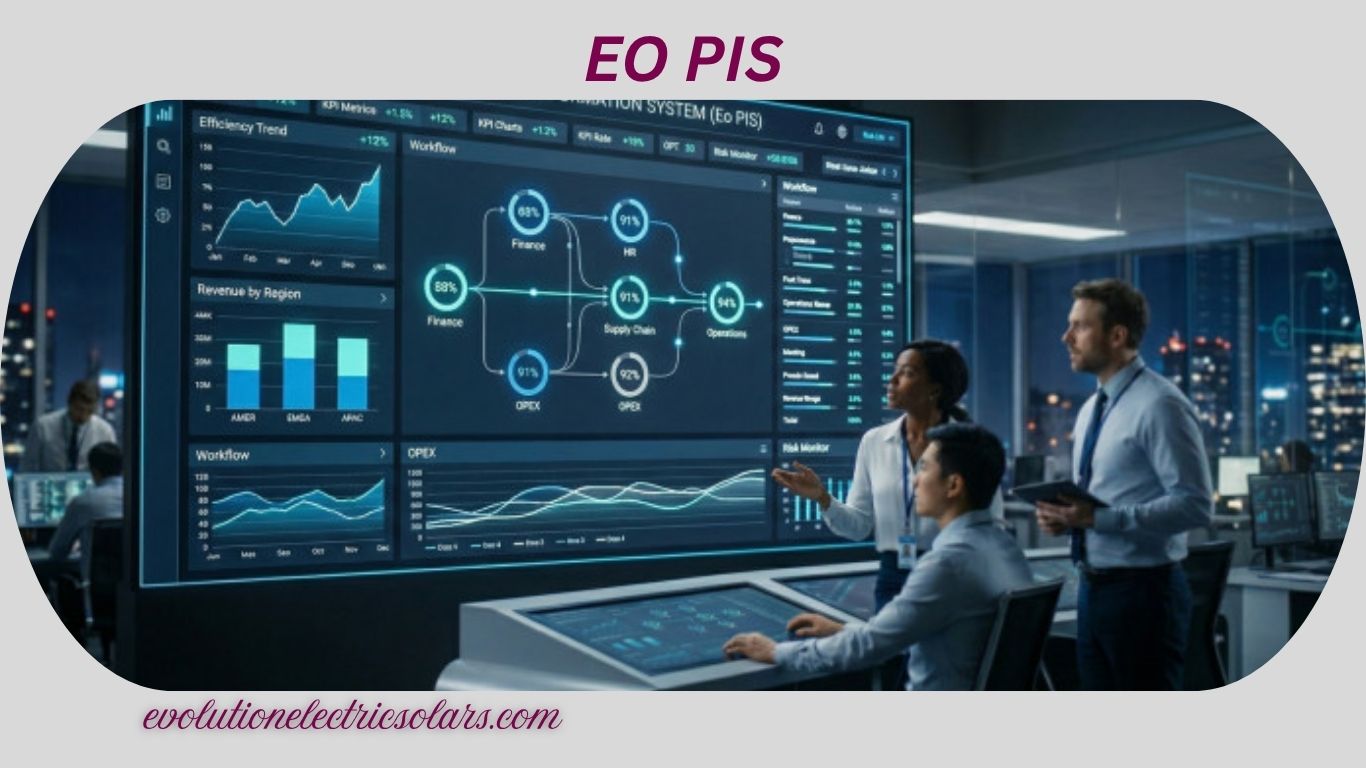
“EO PIS” can have different meanings online, so its exact definition depends on the context. In organizational settings, it is commonly understood as a structured performance information approach that helps collect and organize data, track results, manage resources, and support better decision-making.
EO PIS is not necessarily one specific software product. It can also refer to a broader framework for bringing important operational information together and keeping daily activities aligned with organizational goals. It can be useful in manufacturing, healthcare, education and research, government, public services, and other organizations that rely on measurable performance.
What Is EO PIS?
EO PIS is commonly presented online as a performance information system or Executive Operations Performance Indicator System. In this interpretation, it is designed to connect operational information with management decisions.
A simple definition is:
EO PIS is a structured approach for collecting, organizing, monitoring, and using performance information so an organization can improve operations and make better decisions.
The exact expansion of the acronym varies across websites. Some sources use “Executive Operations Performance Indicator System,” while others use related phrases such as “Enterprise Operations Performance Information System” or “End-of-Period Information System.”
Because of this variation, readers should avoid assuming that every website using “EO PIS” is referring to the same system.
The most useful interpretation for organizational performance is the one focused on performance indicators, operational data, resource use, and decision support.
Under this approach, EO PIS can bring together information such as:
- Operational performance
- Financial results
- Resource utilization
- Employee or workforce performance
- Production data
- Service quality
- Customer or user outcomes
- Project progress
- Risk indicators
- Compliance information
- Strategic objectives
The goal is not simply to collect more information. The goal is to make important information easier to understand and use.
Why EO PIS Matters for Modern Organizations
Organizations generate large amounts of information every day. A manufacturing company may collect production, inventory, maintenance, quality, and shipping data. A hospital may track patient flow, staffing, waiting times, costs, and quality measures. A university may monitor enrollment, research activity, student outcomes, staffing, and budgets.
The problem is often not a lack of data.
The problem is knowing which data matters.
When information remains separated across departments, managers may struggle to see the complete picture. One department can report strong results while another department is experiencing serious problems.
EO PIS addresses this challenge by encouraging organizations to connect important performance information.
For example, a company might report that sales increased by 10%. That sounds positive. However, if customer complaints also increased, delivery times became longer, and operating costs rose sharply, the sales figure alone does not provide a complete picture.
A broader performance system can place these indicators together.
This gives decision-makers better context.
Also Read:Merfez: Complete Guide to Its Meaning, Uses, AI, and Productivity
Recent descriptions of EO PIS emphasize the value of combining cross-functional information into a leadership-level view instead of relying only on isolated departmental reports.
The result can be faster problem identification, better resource allocation, and stronger alignment between daily operations and long-term goals.
Core Functions of EO PIS
The core functions associated with EO PIS can be grouped into four major areas: performance tracking, resource management, decision empowerment, and organizational conformity.
Performance Tracking
Performance tracking is one of the most important functions.
An organization needs to know whether its activities are producing the expected results. EO PIS can help managers monitor selected performance indicators over time.
These indicators may include:
- Productivity
- Revenue
- Operating costs
- Quality levels
- Service response times
- Project completion rates
- Employee performance
- Customer satisfaction
- Equipment utilization
- Resource consumption
Performance tracking also helps organizations compare actual results with planned targets.
For example, if a department has a goal of completing 95% of customer requests within a specific period but achieves only 82%, management has a clear signal that something needs attention.
The system does not automatically solve the problem. Instead, it helps reveal where the problem exists.
Resource Management
Resources are limited in almost every organization.
These resources may include money, employees, equipment, materials, technology, facilities, and time.
EO PIS can help managers understand how resources are being used and where they may be underused or overstretched.
For example, a manufacturing organization could compare machine utilization with production demand. A healthcare organization could compare staffing levels with patient demand. A university could examine how funding is distributed across programs and research activities.
Good resource management is not simply about reducing costs.
Sometimes spending more in one area produces a better overall result.
The important point is to make resource decisions using reliable information rather than assumptions alone.
Decision Empowerment
Decision empowerment means giving managers and leaders the information they need to make informed choices.
A performance system can bring important information together so that decision-makers do not have to spend excessive time searching through separate reports.
A useful EO PIS environment can help answer questions such as:
- What is performing well?
- What is performing below expectations?
- Where is the biggest operational risk?
- Which resources are being overused?
- Which resources are underused?
- What needs immediate attention?
- Are strategic goals being achieved?
- What changed compared with the previous period?
This turns raw data into decision support.
Organizational Alignment
Organizational Alignment refers to keeping activities aligned with established goals, policies, procedures, standards, and strategic priorities.
For example, a government agency may have specific service targets. A hospital may have quality and safety requirements. A manufacturer may have production and quality standards.
EO PIS can help monitor whether actual performance is moving within the expected framework.
This does not mean that every employee or department must work in exactly the same way. Instead, important activities should support the organization’s broader objectives and requirements.
How EO PIS Works
The basic EO PIS workflow can be explained in a simple sequence.
First, information is collected from relevant operational sources.
Second, the information is checked and organized.
Third, important indicators are calculated or selected.
Fourth, the information is presented through reports, dashboards, scorecards, or other management tools.
Finally, managers review the results and take appropriate action.
A simplified workflow looks like this:
Data collection → Data validation → Performance measurement → Analysis → Reporting → Decision-making → Action → Review
This process can be manual, automated, or a combination of both.
Modern information environments may collect data from enterprise systems, customer relationship systems, financial platforms, operational databases, sensors, applications, and other sources. Some recent descriptions of EO PIS also emphasize data integration, validation, storage, analytics, and reporting as important components.
The technology can be sophisticated, but the basic principle remains simple: useful information should lead to better understanding and better action.
EO PIS and Performance Indicators
Performance indicators are central to the EO PIS concept.
A performance indicator is a measurable value that provides information about how well a process, department, project, or organization is performing.
Common examples include:
- Revenue growth
- Operating margin
- Production output
- Defect rate
- Employee turnover
- Patient waiting time
- Student completion rate
- Research output
- Service response time
- Project completion percentage
However, organizations should be careful when selecting indicators.
A metric can be easy to measure but still have little strategic value.
For example, counting the number of meetings held may show activity, but it does not necessarily show whether a team achieved meaningful results.
Good indicators should connect clearly to outcomes.
They should also be understandable, measurable, relevant, and reviewed regularly.
EO PIS vs. KPI Dashboards
EO PIS and KPI dashboards are closely related, but they are not necessarily identical.
A KPI dashboard normally focuses on selected key performance indicators. It may be designed for a department, project, business unit, or executive team.
EO PIS is broader when used as a performance information framework.
It can include KPIs but may also involve:
- Data integration
- Resource information
- Strategic alignment
- Decision rules
- Governance
- Accountability
- Reporting processes
- Performance reviews
One way to understand the relationship is this:
A KPI is a measurement.
A KPI dashboard is a way to display measurements.
An EO PIS framework can organize measurements, information, reporting, and management action into a larger performance process.
This is why EO PIS should not automatically be treated as a replacement for KPI systems.
Instead, it can provide a broader structure around them.
EO PIS in Manufacturing
Manufacturing is one of the industries where performance information can have a direct operational impact.
Manufacturers need to monitor production volume, equipment performance, quality, materials, labor, inventory, maintenance, and delivery.
An EO PIS approach can help bring these areas together.
For example, suppose a factory notices that production output is falling.
A simple report might only show the decrease.
A broader performance information system can help connect the decrease with other indicators, such as:
- Increased machine downtime
- Shortage of raw materials
- Higher defect rates
- Staffing changes
- Maintenance delays
- Increased production cycle time
This creates a more complete picture.
The organization can then investigate the root cause instead of reacting only to the final output number.
EO PIS can also support resource planning by showing which equipment, materials, or labor resources are creating bottlenecks.
EO PIS in Healthcare
Healthcare organizations manage complex operations where performance, resources, service quality, and patient outcomes can be closely connected.
Possible indicators include:
- Patient waiting times
- Bed utilization
- Staff availability
- Appointment volumes
- Readmission rates
- Treatment completion
- Supply levels
- Operating costs
- Service quality measures
An EO PIS-style approach can help administrators understand how these indicators interact.
For example, an increase in patient waiting time might be related to staffing shortages, scheduling problems, higher patient demand, or limited facility capacity.
The system can support operational management, but it should not replace professional clinical judgment.
Healthcare information is also highly sensitive. Any system handling patient information needs strong access controls, privacy protections, security practices, and compliance processes.
Organizations should never assume that adding analytics automatically makes healthcare data safe.
EO PIS in Education and Research
Schools, colleges, universities, and research organizations also depend on performance information.
Possible indicators include:
- Enrollment
- Student retention
- Graduation rates
- Course completion
- Faculty workload
- Research funding
- Publication activity
- Project milestones
- Laboratory resource use
- Budget performance
An education-focused performance system can help leaders understand whether resources are supporting desired educational or research outcomes.
For example, a university might see increasing enrollment but declining course completion. Looking at both indicators together may reveal an issue that enrollment data alone would hide.
Research organizations can also use performance information to monitor project milestones, funding, equipment use, and research outputs.
However, performance measurement should be designed carefully.
Also Read:Connectivity HSSGamepad: Complete Guide to Controller Connections
Education and research involve outcomes that cannot always be reduced to simple numbers.
EO PIS in Government and Public Services
Government agencies often manage large programs, public resources, and service responsibilities.
Performance information can help agencies monitor whether programs are delivering expected results.
Possible indicators include:
- Service delivery times
- Budget utilization
- Program completion
- Application processing
- Public service demand
- Project progress
- Resource utilization
- Compliance measures
A well-designed system can improve transparency and accountability.
It can also help managers identify areas where public resources may not be producing the expected outcomes.
Government use creates additional responsibilities because public-sector data may include personal, financial, employment, or other sensitive information.
Access should therefore be limited according to legitimate responsibilities, and information should be protected through appropriate security and governance controls.
Benefits of EO PIS
The potential benefits of EO PIS depend heavily on how it is designed and used.
Better Visibility
Leaders can gain a clearer view of organizational performance when important indicators are brought together.
Faster Problem Detection
Changes in performance can become visible earlier.
Improved Resource Allocation
Managers can use evidence to determine where money, people, equipment, and time are needed most.
Better Strategic Alignment
Daily operations can be connected more clearly to organizational objectives.
More Consistent Reporting
Standard definitions can reduce confusion between departments.
Improved Accountability
Clear indicators can make responsibilities easier to understand.
Stronger Decision Support
Managers can base important choices on evidence rather than relying only on intuition.
Long-Term Trend Analysis
Historical performance information can reveal patterns that are difficult to see in a single report.
The key point is that these benefits are not automatic. A poorly designed dashboard can create more confusion instead of reducing it.
Challenges and Limitations of EO PIS
EO PIS also has limitations.
The first challenge is data quality.
If the underlying information is incomplete or incorrect, the final report may be misleading.
The second challenge is metric overload.
Organizations sometimes try to measure everything. This can create dashboards with dozens or hundreds of indicators.
More metrics do not necessarily mean better management.
Another challenge is inconsistent definitions.
For example, one department may define “active customer” differently from another. Combining these figures without resolving the difference can produce misleading results.
Technology is another consideration.
Organizations may need integrations between different software systems. These integrations can require significant time, technical knowledge, and maintenance.
There can also be resistance from employees.
People may worry that performance systems are designed primarily for surveillance or punishment. Organizations should clearly explain the purpose of measurement and distinguish useful performance management from inappropriate monitoring.
Finally, performance indicators can sometimes create unintended behavior.
If employees are rewarded only for one metric, they may focus on that metric while ignoring other important outcomes.
This is why balanced measurement is important.
How to Implement an EO PIS Approach
Organizations considering an EO PIS framework should start with goals rather than technology.
Step 1: Define Organizational Objectives
Identify what the organization is trying to achieve.
Step 2: Identify Critical Performance Areas
Determine which operational areas have the greatest effect on those objectives.
Step 3: Select Useful Indicators
Choose a limited number of meaningful measures.
Step 4: Define Each Metric Clearly
Document what each indicator means, how it is calculated, where its data comes from, and how often it is updated.
Step 5: Check Data Quality
Before building advanced dashboards, confirm that the underlying information is reliable.
Step 6: Connect Data Sources
Where necessary, integrate financial, operational, HR, customer, production, or other systems.
Step 7: Build Practical Reports
Create dashboards that focus on the information users actually need.
Step 8: Establish Accountability
Define who reviews each indicator and who is responsible for responding to problems.
Step 9: Review the System
Indicators should change when organizational priorities change.
Step 10: Measure the Value of the Framework
Ask whether the system is actually improving decisions, resource use, performance, or accountability.
This approach prevents an organization from purchasing or building technology without first understanding the management problem it needs to solve.
EO PIS, Data Privacy, and Security
Any performance information system can involve sensitive information.
Depending on the organization, data may include employee records, financial information, customer information, operational details, research data, or government records.
Security should therefore be considered from the beginning.
Important practices can include:
- Role-based access
- Strong authentication
- Encryption
- Audit logs
- Secure data storage
- Regular access reviews
- Data retention policies
- Backup procedures
- Incident response plans
- Staff security training
Organizations should also collect only information that is necessary for legitimate purposes.
A performance system should not become an excuse for collecting unlimited personal data.
For U.S. organizations, privacy and security obligations can vary depending on the industry, type of information, and applicable federal or state requirements. Healthcare, education, financial services, government, and employment environments may have different legal and regulatory considerations.
Legal review may therefore be appropriate before implementing a system that processes sensitive information.
How to Evaluate an EO PIS System
If an organization is considering an EO PIS platform or framework, it should evaluate more than the dashboard design.
Important questions include:
- What business problem does the system solve?
- Which data sources can it connect to?
- How is data quality managed?
- Can metric definitions be standardized?
- Can users trace numbers back to their sources?
- How frequently is information updated?
- Can different user roles have different access?
- How are security controls implemented?
- Can the system scale as the organization grows?
- Does it integrate with existing software?
- How much maintenance is required?
- Can managers convert findings into specific actions?
A professional evaluation should also consider total cost.
The price of software is only one part of the investment. Data integration, implementation, training, governance, maintenance, security, and staff time can all affect the actual cost.
The Future of EO PIS and Performance Intelligence
Performance management is increasingly influenced by automation, cloud computing, advanced analytics, and artificial intelligence.
These technologies can make performance systems more powerful.
For example, automated systems can identify unusual changes in data. Predictive analytics can help estimate future demand. AI-based tools can summarize large amounts of operational information and highlight areas that may deserve human review.
However, automation also creates risks.
An AI system can identify a pattern without understanding the organizational context behind it.
For example, a sudden decrease in productivity may be caused by a temporary event, a planned maintenance period, a change in measurement, or a genuine operational problem.
The system can flag the change.
People still need to interpret it.
Future EO PIS environments are therefore likely to combine automated data processing with human judgment rather than completely replacing decision-makers.
The strongest systems will focus not only on measuring what happened but also on helping organizations understand why it happened and what response makes sense.
Is EO PIS a Standardized Term?
This is one of the most important questions about the keyword.
At present, “EO PIS” should not be treated as one universally standardized business or technology term.
Current online sources use several different expansions and interpretations. Some describe it as an Executive Operations Performance Indicator System, while others associate it with enterprise operations, end-of-period information, procurement, personnel information, or other organizational concepts.
That means context matters.
Also Read:Wallpostmedia Com: A Complete Guide to Digital Publishing and SEO
If someone gives you an EO PIS document, software name, course, policy, or business proposal, the safest approach is to check the definition provided by that specific organization.
This is especially important before making business, financial, technical, or compliance decisions.
Acronyms are often reused across industries.
The same abbreviation can have completely different meanings in different environments.
Therefore, the practical meaning of EO PIS should be confirmed from an authoritative source rather than assumed from the acronym alone.
Frequently Asked Questions About EO PIS
1. Can EO PIS replace an ERP system?
No. EO PIS and ERP systems serve different purposes.
An ERP system generally supports core business processes such as finance, procurement, inventory, manufacturing, human resources, and other operations.
An EO PIS-style framework can use information from ERP and other systems to monitor performance and support management decisions.
In many cases, they can work together rather than compete with each other.
2. Does EO PIS require artificial intelligence?
No.
An organization can build a useful performance information system using databases, spreadsheets, dashboards, reporting software, and established analytics methods.
Artificial intelligence can add capabilities such as anomaly detection, forecasting, or automated summaries, but AI is not required for the basic EO PIS concept.
The quality of the data and performance indicators remains more important than using advanced technology simply because it is available.
3. How often should EO PIS data be updated?
There is no single correct update frequency.
The appropriate frequency depends on the type of activity.
Manufacturing equipment may require near-real-time monitoring, while a strategic financial indicator may only need daily, weekly, or monthly updates.
The update schedule should match the speed at which a decision needs to be made.
Updating information every minute provides little value if managers only need the information once a week.
4. Who should be responsible for managing EO PIS information?
Responsibility should normally be shared.
Technical teams may manage data infrastructure and integrations. Department leaders may own specific metrics. Senior management may decide which indicators are strategically important. Governance or compliance teams may help establish rules for data quality, privacy, and access.
A clear ownership model helps prevent situations where everyone uses the information but nobody is responsible for keeping it accurate.
5. Is EO PIS useful for small businesses?
Yes, the underlying idea can be useful for small businesses, although a small organization may not need a complex system.
A small business could begin with a simple set of indicators covering sales, costs, cash flow, customer service, inventory, productivity, and other important areas.
The goal should be clarity rather than complexity.
A simple and accurate dashboard is often more useful than an expensive system filled with unnecessary metrics.
Conclusion
EO PIS is a developing and context-dependent term that is increasingly used online in discussions about organizational performance, operational information, and executive decision-making. Because different sources give the acronym different expansions, readers should verify the specific definition being used in their industry or organization.
When EO PIS is used to describe a performance information framework, its main purpose is clear: help organizations turn operational data into useful information for action.
Its core functions include performance tracking, resource management, decision empowerment, and organizational conformity.
The concept can apply to manufacturing, healthcare, education and research, government, public services, and many other environments.
The most valuable EO PIS implementation is not necessarily the one with the most technology or the largest number of metrics. It is the one that provides accurate information, uses meaningful indicators, protects sensitive data, and helps the right people make better decisions at the right time.
For organizations considering an EO PIS approach, the best starting point is not a dashboard or software purchase. Start with the organization’s goals, identify the decisions that need better information, select meaningful indicators, establish data-quality rules, and then choose technology that supports those requirements.
In simple terms, EO PIS is about connecting performance information with practical management action. When that connection is designed carefully, organizations can gain better visibility, use resources more effectively, identify problems earlier, and stay more closely aligned with their strategic objectives.